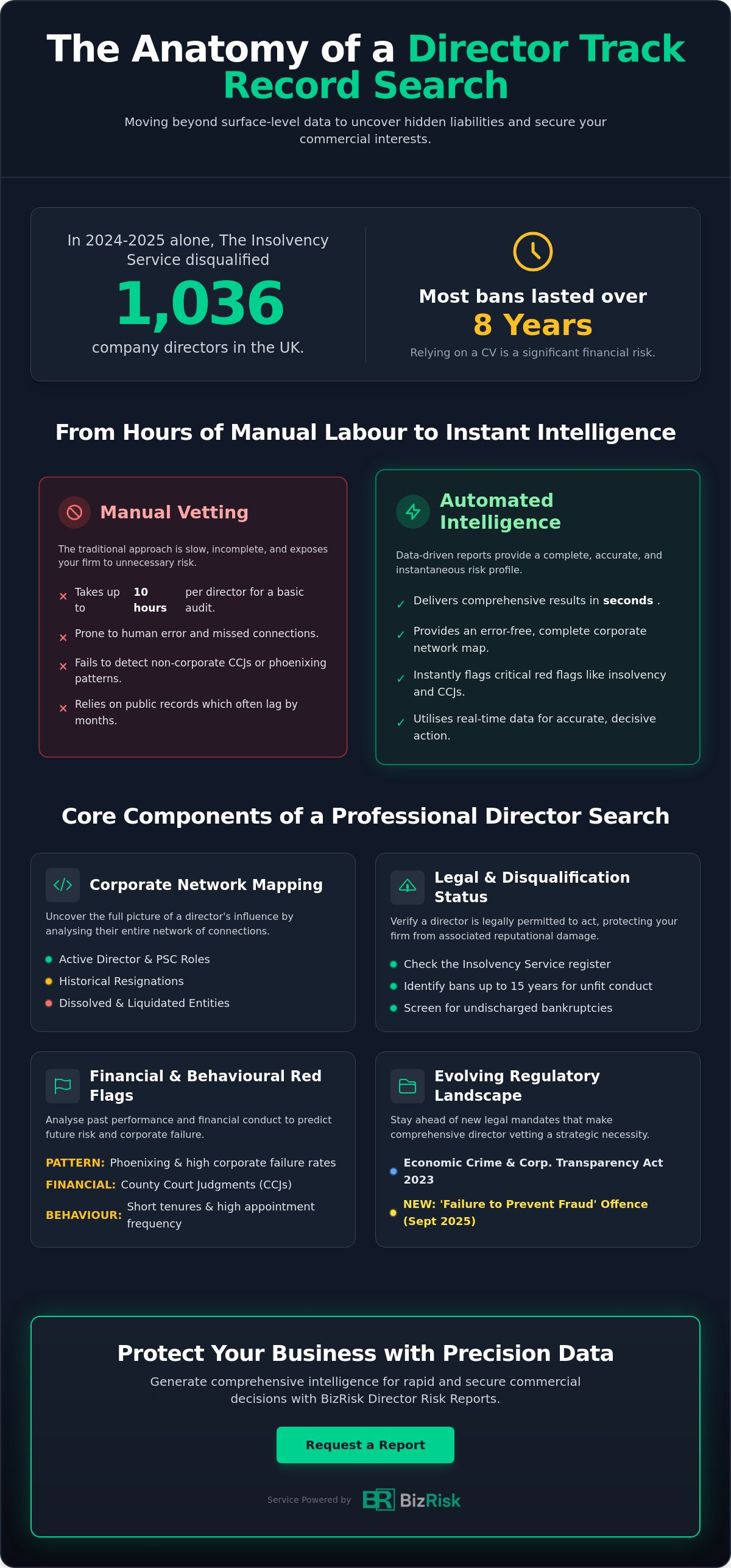
The Insolvency Service disqualified 1,036 company directors in the 2024-2025 reporting year alone. Most bans lasted over eight years. Relying on a surface-level director track record search exposes your firm to these high-risk individuals. Manual verification is slow. It is often inaccurate. It fails to catch phoenix company patterns before they damage your balance sheet.
You know that corporate transparency is shifting. New mandates under the Economic Crime and Corporate Transparency Act 2023 make due diligence a legal priority. This article provides the blueprint for high-speed director vetting. You will learn to mitigate risk with clinical precision. We show you how to secure your commercial interests through rapid, data-driven intelligence.
We break down the process into three phases. First, we identify disqualification markers and insolvency history. Second, we map the director's entire corporate network to find hidden liabilities. Finally, we examine the failure to prevent fraud offence coming in September 2025. This is your guide to total corporate oversight.
Key Takeaways
- Identify the forensic requirements of a professional director track record search to move beyond surface-level CV data.
- Map a director’s complete corporate network by categorising active roles, resignations, and dissolved entities.
- Replace 10-hour manual audits with automated risk intelligence to achieve instant, error-free results.
- Detect critical red flags, such as County Court Judgments (CCJs) and insolvency patterns, to mitigate financial liability.
- Utilise BizRisk Director Risk Reports to generate comprehensive, data-driven intelligence for rapid commercial decisions.
The Strategic Necessity of a Director Track Record Search
A director track record search is a forensic investigation into professional history. It is a vital utility for UK firms. Surface-level CVs are insufficient for high-value contracts. They are curated narratives. They ignore historic governance failures. Professional Management due diligence requires data, not promises. You must look beyond the self-reported successes to find the hidden liabilities.
UK directors carry heavy legal burdens. The Companies Act 2006 mandates specific duties that ensure corporate accountability. Violating these leads to disqualification or personal liability. In the 2024-2025 reporting year, the Insolvency Service disqualified 1,036 directors. Most were banned for over eight years. This is a high-stakes environment. Individual behaviour dictates corporate solvency. If a director has a history of liquidations, your investment is insecure.
The regulatory landscape is tightening. The Economic Crime and Corporate Transparency Act 2023 introduced mandatory identity verification for all directors. A new corporate offence of failure to prevent fraud comes into force on 1 September 2025. Companies will be held liable for employee fraud if they lack adequate prevention measures. This makes thorough vetting a strategic mandate. You can't afford to ignore a partner's past. Protecting your interests starts with precision data from BizRisk.
Limitations of Standard Companies House Queries
Companies House is a registrar. It is not a validator. Public records often lag behind real-world financial distress by months. Relying on free registers to identify phoenixing is difficult through manual searching. You'll likely miss non-corporate County Court Judgments (CCJs) against the individual. You might overlook links to dissolved entities that were struck off before formal insolvency. Free data provides a snapshot. It doesn't provide a narrative of risk.
Predicting Corporate Failure Through Individual Patterns
Past performance is the most accurate predictor of future risk. Identifying a serial failure profile is critical before committing capital. If a director's previous firms consistently enter liquidation, the pattern is rarely coincidental. These behavioural markers impact a firm's credit appetite. Lenders use advanced data to assess risk. You must do the same. A comprehensive director track record search reveals whether a potential partner is a liability or an asset.
Core Components of Professional Director Due Diligence
A professional director track record search requires a granular analysis of specific data points. You must move beyond simple name checks. High-stakes vetting involves cross-referencing active roles, resignations, and dissolved entities. This process reveals the true professional trajectory of an individual. It identifies whether a director builds sustainable value or leaves a trail of corporate collapses. You need a complete view of their network to mitigate risk effectively.
Identifying Persons with Significant Control (PSC) is a non-negotiable step. The PSC register exposes the actual influence behind a company. Some directors hold titles without authority. Others exert control without a formal board seat. You must verify these links to understand the corporate hierarchy. Appointment frequency and duration also serve as critical indicators. A director with twenty appointments in two years signals instability. Short tenures often precede financial distress. Rapidly fluctuating directorships are often used to obfuscate accountability.
Disqualification and Legal Standing
Verification begins with the Insolvency Service register. You must check for active disqualification orders. Under the Company Directors Disqualification Act 1986, individuals can be barred for up to 15 years for unfit conduct. Engaging an undischarged bankrupt in a leadership role is a severe risk. It violates the legal responsibilities of a director and can lead to personal liability for the board. Rapid screening ensures you don't partner with legally restricted individuals. It protects your firm from the reputational damage of associated legal failures.
Financial History and Dissolved Entities
Analyse the director’s historical portfolio to calculate a failure rate. High rates of dissolution suggest poor management or intentional avoidance of debt. Distinguish between strategic liquidations, which are planned and orderly, and distressed collapses that harm creditors. One specific pattern to watch for is phoenixing. Phoenixing is the practice of carrying on the same business through a successive series of companies. This behaviour often indicates a desire to shed liabilities whilst retaining assets. It is a major red flag for credit insurers and suppliers alike. If you require assistance identifying these complex patterns within a director track record search, you can speak with our intelligence specialists for guidance.
Manual Search vs Automated Risk Intelligence
Manual auditing is a strategic bottleneck. Conducting a thorough director track record search via Companies House and the Insolvency Service often requires over 10 hours of manual labour. This approach is prone to failure. Human investigators frequently miss subtle connections between entities or fail to spot a shared address between seemingly unrelated firms. Automated risk intelligence generates comprehensive reports in under two minutes. It eliminates the delay between inquiry and action. Speed is your primary defensive asset.
Precision matters. In a volatile UK market, data that is even a week old can be dangerous. Real-time intelligence is the only way to ensure customer due diligence measures are met with clinical accuracy. Manual cross-referencing across multiple browser tabs creates gaps. It overlooks the digital footprints that signal impending collapse or fraudulent intent. Automated systems provide a data-driven view that manual efforts cannot replicate. They offer reassurance through speed and accuracy.
Modern vetting relies on massive data aggregation. This involves pulling intelligence from over ten distinct sources simultaneously. We aggregate corporate filings, legal registers, insolvency notices, and digital asset data. This multi-dimensional approach identifies risks that a single-source search ignores. It provides the level of certainty required for high-stakes decision-making. You receive a structured narrative of risk rather than a pile of disconnected documents. It is a vital utility for the modern professional.
The Speed-Accuracy Trade-off in Due Diligence
Manual searches often miss shadow directorships. These are individuals who exert influence without being formally registered. They represent hidden links in a chain of corporate failure. Identifying them manually requires deep-dive investigation that most firms cannot afford. Delayed intelligence is expensive. It stalls high-speed commercial negotiations and allows competitors to move first. Automated platforms solve this. They organise fragmented data into actionable risk profiles. You get clarity without the wait. Logic and data replace intuition.
Aggregating Multi-Source Intelligence
Corporate filings only tell half the story. Effective due diligence combines these with domain and digital risk data. Discrepancies between an official filing and a company’s digital footprint are major red flags. For instance, a director might claim a clean record whilst their associated domains show signs of malicious activity. This level of insight supplements a standard UK Company Risk Report. It ensures your background checks are exhaustive and legally robust. It feels like a high-performance tool because it is one.
Identifying Critical Red Flags in Director Behaviour
Vetting requires a systematic approach. Categorise red flags into three segments: financial, legal, and behavioural. Financial flags involve liquidity crises. Legal flags involve regulatory breaches. Behavioural flags involve patterns of evasion. A comprehensive director track record search uncovers these hidden layers. You cannot rely on a single data point. You need a holistic view of professional conduct. Protecting your commercial interests requires identifying these markers before they escalate into corporate failure.
Be alert to shadow directors. These are individuals who act as directors without formal appointment. They pull strings from the background. They often have histories of disqualification or bankruptcy. They operate through proxies to avoid scrutiny. This creates a significant governance gap. It exposes your firm to unregulated influence and potential fraud. Identifying these hidden links is a core component of advanced due diligence.
Identify the resignation rush. This is a cluster of departures immediately preceding a company entering administration. It signals that leadership has abandoned the ship. It indicates a lack of confidence in the firm's recovery. This pattern is a primary indicator of imminent corporate failure. It shows a desire to distance oneself from the fallout of insolvency. If you detect these patterns during your investigation, contact our risk consultants for a detailed analysis of the director’s history.
CCJs and Personal Insolvency Signals
Personal financial behaviour mirrors corporate management. A County Court Judgment (CCJ) against a director is a leading indicator of mismanagement. It suggests a failure to meet basic financial obligations. CCJs remain on a credit file for six years. They are relevant risk factors for the duration of that period. Differentiate between minor administrative disputes and systemic non-payment. Systemic issues suggest a fundamental lack of fiscal discipline. They are often precursors to corporate insolvency.
Frequent Resignations and Short Tenures
Tenure reflects accountability. Frequent resignations suggest jump ship behaviour. If a director has multiple exits within a 12-month period, assume internal turmoil. Short tenures prevent the development of a strategic legacy. They allow individuals to evade the long-term consequences of their decisions. This lack of strategic accountability is a major risk for long-term partners. A director track record search reveals if a candidate is a builder or a transient risk. Logic and data must drive your final assessment.
Executing Rapid Due Diligence with BizRisk
BizRisk is the definitive utility for a modern director track record search. We deliver intelligence with calculated accuracy. Manual searching is obsolete. Our platform provides a modular Director Risk Report designed for rapid decision-making. It breaks down complex histories into digestible, sequential phases. You gain reassurance through speed. There is no lingering on details. We move you quickly from a starting point to a conclusion. This mirrors the speed of the software itself.
Each report follows a logical workflow. We present appointment history, insolvency links, and red flag alerts in a visual hierarchy. This structure acts as a functional guide rather than a narrative. It respects your time. It minimises cognitive load. You receive exactly what is needed without unnecessary dialogue. The persona of our tool is that of a specialist. It provides intelligence with cold, calculated precision. It is a vital utility for high-stakes commercial interests.
Instant Director Risk Scores
We quantify risk using a data-driven algorithm. This produces a single, structured metric. It allows for immediate risk assessment without lingering on fragmented details. The BizRisk score aggregates data from over ten sources to provide a clinical assessment of risk. This structured approach removes intuition from the process. It prioritises logic and comprehensive coverage. You can make a bold decision based on data, not gut feeling.
The score is dynamic. It reflects the latest filings and legal updates from Companies House and the Insolvency Service. Use this metric to set clear internal thresholds for partnership. If a score falls below your requirements, the report identifies the specific failure points. This allows for rapid rejection or further forensic inquiry. It is a high-performance tool for a high-stakes market. Reliability is the core of our engine.
Integrating Director and Company Data
Intelligence is most effective when unified. BizRisk links individual track records with corporate and domain risk data. This creates a tripartite view of any UK business engagement. You see the director, the firm, and the digital footprint in one interface. This scale of oversight is vital for AML and KYB compliance. It ensures your due diligence is exhaustive. It makes it harder for fraudulent or fictitious directors to operate within your network.
The transition from initial vetting to long-term monitoring is seamless. Start with a Free Risk Report to assess immediate threats. For high-stakes operations, subscription-based monitoring provides professional urgency. It alerts you to new CCJs, resignations, or insolvency filings the moment they occur. Secure your business with an instant Director Risk Report. Our platform acts as a silent, high-speed facilitator. Use BizRisk to eliminate uncertainty and protect your firm’s future.
Secure Your Commercial Interests with Precision Data
Manual due diligence is a strategic liability. Effective risk mitigation requires a transition from slow, error-prone audits to high-speed intelligence. You now understand the necessity of identifying shadow directors and the "resignation rush" before financial collapse. A rigorous director track record search is the foundation of modern corporate oversight. It ensures that your partnerships are built on verified history rather than curated CVs.
BizRisk provides the clinical, data-driven engine required for this high-stakes environment. We aggregate instant risk intelligence from over 10 sources. Our clinical, data-driven risk scoring is already used by UK professionals for rapid due diligence. You can identify disqualifications, CCJs, and complex network links in under two minutes. This level of accuracy allows you to act with total confidence.
Don't leave your firm’s security to chance. Take control of your vetting process today. Request a structured Director Risk Report from BizRisk. Protect your balance sheet and move forward with the certainty of data-backed intelligence.
Frequently Asked Questions
What is included in a director track record search?
A professional search includes complete appointment history, active and resigned roles, and disqualification status. It also maps Persons with Significant Control (PSC) data and historical portfolio performance. You receive a structured view of every corporate entity linked to the individual, including dissolved and insolvent firms.
How far back does a director background check go in the UK?
Digital records generally cover a director’s entire professional history within the Companies House registrar. This includes appointments spanning several decades. County Court Judgments (CCJs) remain visible for six years. Disqualification orders are tracked based on the length of the ban, which can reach 15 years under the Company Directors Disqualification Act 1986.
Can I see if a director has been involved with insolvent companies?
Yes, professional searches link individuals to all associated entities in liquidation or administration. You can identify patterns of corporate failure across multiple dissolved firms. This exposes "serial failure" profiles that curated CVs often omit. Mapping these links is a core component of a director track record search.
Is a director search on Companies House enough for due diligence?
No, Companies House acts as a registrar rather than a validator. It does not verify the accuracy of all filed data. It also lacks non-corporate financial data such as personal CCJs or digital asset risks. Comprehensive due diligence requires multi-source aggregation to identify hidden liabilities and shadow directorships.
What are the most common red flags in a director search?
Critical red flags include active disqualification orders, undischarged bankruptcy, and personal CCJs. Watch for high resignation frequencies and "phoenixing" patterns. Cluster resignations occurring immediately before a firm enters administration are also major indicators of internal turmoil and lack of accountability.
How long does it take to get a full director risk report?
Automated platforms deliver a full director track record search in under two minutes. Manual auditing typically requires over 10 hours of cross-referencing. Rapid delivery ensures you can act on real-time data during high-speed commercial negotiations without compromising accuracy.
Can I check for shadow directors using an automated tool?
Yes, automated tools identify shadow directors by cross-referencing shared addresses and corporate links. These individuals exert influence without formal appointment and often have histories of disqualification. Aggregating data from over ten sources exposes these hidden governance gaps that manual searches frequently miss.
Why is a director risk score better than just reading a report?
A risk score quantifies complex data into a single, structured metric. It allows for instant decision-making. It removes human intuition and replaces it with clinical, data-driven accuracy. This structured approach facilitates rapid rejection or forensic deep-dives based on objective risk thresholds.