
A static credit report is a post-mortem of a business that no longer exists. You recognise that the moment a data export is generated, its value begins to erode. Relying on manual Companies House searches or annual reviews leaves your organisation exposed to undisclosed insolvency filings and director disqualifications. It's a reactive approach that fails the speed of modern commerce. Manual monitoring is time-consuming; it's also prone to critical oversights that jeopardise your corporate standing.
Integrate real-time business risk alerts to transition your due diligence from historical analysis to proactive protection. This guide explains how to automate oversight of your entire supply chain and secure instant intelligence on CCJs or sudden director exits. We examine how live data facilitates faster decisions and mitigates the rising risks of personal director liability under 2026 regulations. Discover how to replace outdated workflows with a high-performance system designed for immediate risk mitigation and clinical precision.
Key Takeaways
- Shift from obsolete annual reviews to continuous monitoring for precise, high-stakes decision-making.
- Understand how real-time business risk alerts aggregate data from ten distinct UK sources to generate instant risk scores.
- Reduce resource allocation and eliminate human error by automating the transcription of corporate filings and supplier audits.
- Establish specific "Kill" and "Warn" thresholds to identify critical red flags, including director appointments with histories of failed ventures.
- Implement automated oversight across companies, directors, and domains to secure immediate corporate intelligence.
Understanding Real-Time Business Risk Alerts in a UK Context
Real-time business risk alerts are automated notifications triggered by immediate shifts in a company's legal, financial, or digital status. They represent a fundamental transition from traditional, periodic reviews to continuous, data-driven monitoring. In the UK's volatile corporate environment, delay is a liability. Precision requires live intelligence that informs high-stakes decisions the moment data changes. This system replaces the uncertainty of "point-in-time" checks with a persistent stream of actionable data.
Immediacy is vital whilst navigating the current UK landscape. Recent regulatory shifts, such as the Finance Act 2024 and the 2026 CIS non-compliance rules, have increased personal liability for directors. If a partner company faces an insolvency filing or a sudden leadership exit, the window for mitigation is narrow. Waiting for a monthly audit is no longer a viable strategy. Effective oversight requires categorising alerts into three distinct streams: financial insolvency, leadership transitions, and digital domain integrity. This structured approach ensures that no critical red flag remains unnoticed.
The Failure of Static Due Diligence Reports
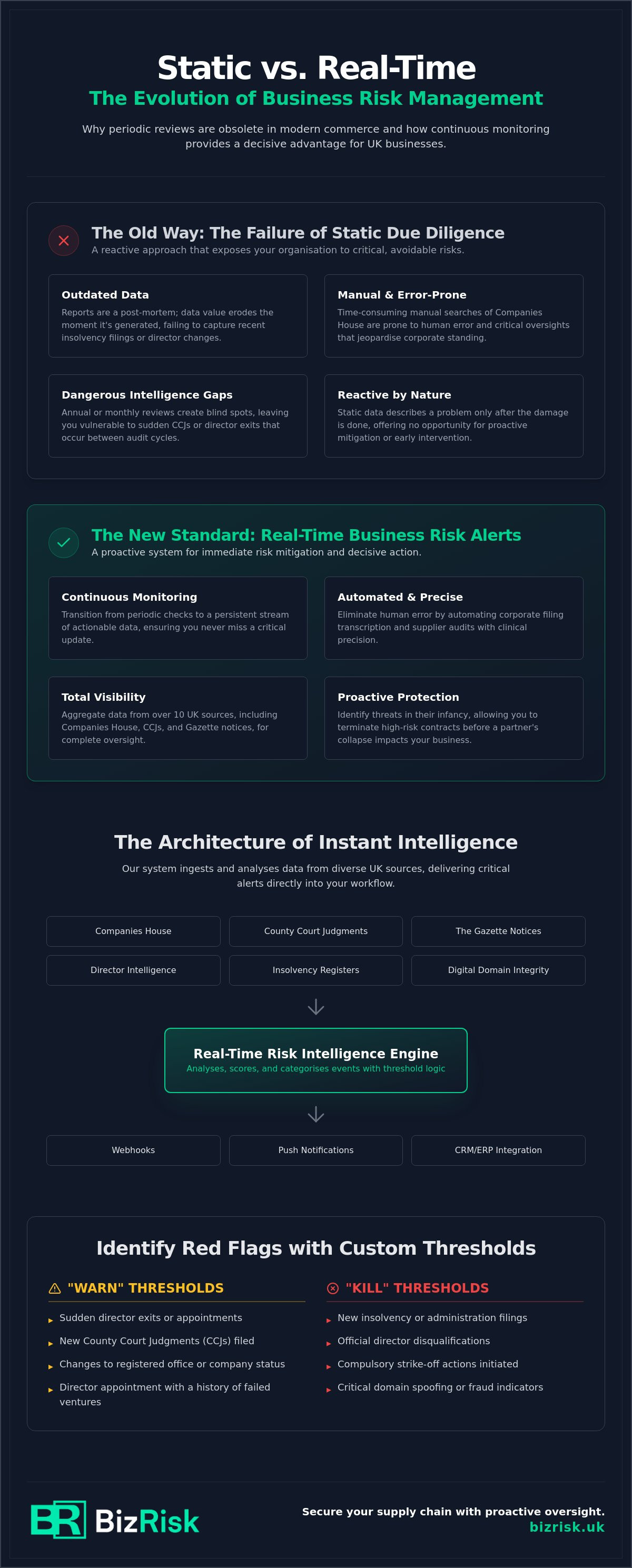
Traditional due diligence relies on static reports. These snapshots provide data that often expires within twenty-four hours of generation. They fail to capture sudden insolvency filings or clandestine director appointments occurring between audit cycles. Relying on manual checks creates a dangerous intelligence lag amongst procurement and legal teams. This gap exposes organisations to counterparty risk that could have been avoided. Static data is a post-mortem; it describes a problem after the damage is done. Modern corporate oversight demands a proactive alternative that identifies threats in their infancy.
Defining the Scope of Business Risk Intelligence
Comprehensive intelligence requires a broad, multi-source scope. Integrating enterprise risk management frameworks into your daily operations ensures that your monitoring covers every potential vulnerability. The deployment of real-time business risk alerts ensures coverage across three critical pillars:
- Corporate Intelligence: Monitor Companies House filings, County Court Judgments (CCJs), and Gazette notices for signs of financial distress or compulsory strike-off actions.
- Director Intelligence: Track new appointments, disqualifications, and the history of individuals involved in failed ventures to prevent "phoenixing" risks.
- Digital Intelligence: Identify domain spoofing and infrastructure vulnerabilities that precede corporate fraud.
By synchronising these data points, businesses move from a reactive posture to one of clinical efficiency. You gain the ability to terminate high-risk contracts or renegotiate terms before a partner's collapse impacts your own balance sheet. This is the new standard for UK corporate oversight: speed, accuracy, and total visibility.
The Architecture of Instant Corporate Risk Intelligence
The architecture of real-time business risk alerts functions as a high-speed intelligence hub. It ingests data from over ten distinct UK sources simultaneously; these include Companies House, the Individual Insolvency Register, and the Gazette. This multi-source ingestion creates a comprehensive view of a company's legal and financial standing. It aligns with the UK government's risk management principles by ensuring that data collection is systematic and proportionate to the potential impact. Rapid ingestion leads to rapid response.
Threshold logic is the core of this architecture. It distinguishes between a routine filing and a critical red flag with clinical precision. A change in registered office might be administrative; a director disqualification is catastrophic. The risk engine applies precise weighting to these events based on their legal and financial severity. For maximum utility, automated delivery via webhooks or push notifications is essential. Traditional email alerts often sit unread in inboxes. Webhooks push data directly into your CRM or ERP system for immediate action. This ensures that intelligence is integrated into your digital workflow.
Aggregating Data from Diverse UK Sources
Effective oversight requires more than just registry checks. It involves monitoring court records for CCJs and scanning the dark web for business domain mentions or credential leaks. Cross-referencing director track records across multiple entities is critical for identifying shadow directors or individuals with a history of insolvency. This multi-layered approach prevents the "phoenixing" of companies from going unnoticed. You can assess these complex relationships instantly through a Company Risk Report; it provides the clarity needed for rapid vetting. Precision is the priority.
Dynamic Risk Scoring and Behavioural Baselines
A singular, dynamic risk score reflects the immediate health of a UK business entity. This score evolves as new data enters the system, shifting in response to every filing and legal update. It identifies unusual behaviour such as rapid director turnover or frequent address changes that often precede corporate collapse. These behavioural baselines allow the engine to detect anomalies before they manifest as financial loss. The system calculates risk scores by weighting event severity against historical behavioural baselines to ensure high-impact filings receive immediate priority. This data-driven approach removes intuition from the equation and replaces it with cold, calculated accuracy.
Proactive Monitoring vs Reactive Audits: A Comparison
Reactive audits are historical post-mortems. They document losses that have already occurred. Proactive monitoring identifies the trajectory of risk before the balance sheet is impacted. This shift represents a fundamental change in resource allocation. Manual supplier audits require significant man-hours; they are also vulnerable to human error during data transcription. Automating this process through real-time business risk alerts ensures that your data is current, accurate, and actionable. It replaces the fatigue of manual oversight with the precision of a digital engine.
Decision speed is the primary differentiator. Boards empowered by live intelligence can terminate high-risk contracts or renegotiate terms before a partner enters administration. This level of oversight is essential when consulting the UK government's overseas business risk guidance or managing complex domestic supply chains. The cost of a monitoring subscription is negligible compared to the impact of a six-figure bad debt or a total supply chain collapse. Reliability is built through constant surveillance, not annual snapshots.
Efficiency Gains in Corporate Compliance
Automate your business background check process across thousands of suppliers. This removes the burden of repetitive filing searches from legal teams. They can then focus on high-level strategy and complex litigation. Standardising risk thresholds across the entire organisation ensures consistent corporate behaviour. Every department operates from the same live data source. You can start this transition today with a Free Risk Report to identify immediate vulnerabilities in your current portfolio. Precision drives efficiency.
The Financial Impact of Delayed Intelligence
Delayed intelligence is expensive. Trading with a company that has already entered administration results in immediate capital loss and complex legal recovery efforts. It also threatens your reputation. Association with disqualified directors or fraudulent entities can trigger regulatory scrutiny and damage brand equity. Early warning systems also mitigate the risk of domain-based fraud. They alert you to infrastructure changes that suggest a partner's digital security has been compromised. Speed is your most effective shield. Precise data allows you to act whilst others are still waiting for their monthly report. Eliminate the intelligence gap to secure your margins.
Critical Indicators: Setting Your Alert Thresholds
A warning without a protocol is merely noise. Precision in real-time business risk alerts requires a binary distinction between "Kill" and "Warn" signals. You must categorise incoming data based on its immediate threat to your operations. Financial red flags, such as winding-up petitions or multiple County Court Judgments (CCJs), demand immediate escalation. These are not administrative anomalies; they are indicators of systemic failure. Conversely, address changes or minor leadership shifts may only require a "Warn" status for secondary review.
Director red flags are equally critical. Tracking appointments of individuals with a documented history of failed ventures prevents exposure to "phoenix" company risks. Domain red flags, including typosquatting and unauthorised DNS changes, identify potential fraud before it manifests as a security breach. Monitoring these indicators in isolation is insufficient. You must synthesise legal, financial, and digital data to create a holistic risk profile. Use a Director Risk Report to verify the track record of any new appointee before they gain control of a partner entity.
Corporate and Legal Red Flags
Compulsory strike-off notices are the ultimate signal of administrative failure. They indicate that a company has ceased to communicate with Companies House; this is often a precursor to insolvency. Sudden changes in Persons with Significant Control (PSC) also represent a high-risk factor. These shifts can signal a hostile takeover or a desperate attempt to obscure ownership. Constant monitoring of the Insolvency Service for director disqualification updates ensures that your board is never blindsided by a partner's legal incapacity. Speed is the only defence against administrative decay.
Developing a Fixed Response Framework
Establish a tripartite response framework to standardise corporate behaviour. Assign specific actions to each alert tier to minimise cognitive load during high-stakes events:
- Tier 1 (Audit): Minor filings or address changes. Trigger a standard internal review.
- Tier 2 (Pause): Significant CCJs or PSC shifts. Suspend new orders whilst conducting deep-dive due diligence.
- Tier 3 (Terminate): Winding-up petitions or strike-off notices. Initiate contract termination protocols immediately.
Integrate these alerts into existing CRM or ERP workflows via API to ensure delivery. This prevents intelligence from stalling in an inbox. It ensures the right data reaches the right stakeholder amongst the leadership team instantly. Automation ensures consistency. It removes the variability of human judgement and replaces it with a fixed, data-driven protocol. Your response must be as rapid as the alert itself.
Implementing Real-Time Oversight with BizRisk
BizRisk provides the technical infrastructure required for immediate corporate oversight. By aggregating data from ten plus UK sources, the platform delivers a definitive risk score that informs rapid decision-making. This is not a passive data feed; it is a high-performance engine designed for clinical precision. You can enter a company name and receive structured, actionable data in minutes. This speed is essential for maintaining a competitive edge whilst mitigating counterparty risk in a volatile market. It transforms raw data into a functional utility for legal and procurement teams.
Transitioning from a Free Risk Report to a full SaaS monitoring subscription enables persistent surveillance of your entire portfolio. Real-time business risk alerts ensure that you are never operating on obsolete information. The platform automates the heavy lifting of data aggregation; this allows your team to focus on high-level strategic execution rather than manual filing searches. Reliability is achieved through this constant, calculated analysis of legal and financial filings. It replaces the uncertainty of periodic audits with a continuous stream of intelligence.
The BizRisk Workflow: Speed and Precision
The BizRisk workflow is designed for maximum efficiency and minimal cognitive load. Input target entities into the system to initiate continuous, automated monitoring. Access structured due diligence reports that evolve dynamically as new filings occur. This ensures your oversight remains current without the need for manual refreshes or data entry. Customise alert frequency to match your specific risk appetite. This modular approach allows you to prioritise high-stakes partnerships whilst maintaining a baseline of awareness across your broader supply chain. Speed is the priority; accuracy is the result.
Securing Your Supply Chain and Partnerships
Supply chain integrity requires constant vigilance and zero-trust verification. Use real-time business risk alerts to detect early signs of distress amongst your key partners before they manifest as financial losses. Leverage Director Risk Reports to vet potential board members or new corporate partners with clinical accuracy. This prevents the infiltration of individuals with a history of administrative failure or disqualification into your ecosystem. Additionally, monitor your own digital presence with Domain Risk Reports to prevent corporate identity theft and unauthorised infrastructure changes. Protect your business with real-time alerts at BizRisk today to secure your corporate future with data-driven precision.
Secure Your Corporate Future with Live Intelligence
Static due diligence is an obsolete practice that invites unnecessary exposure. Shifting from periodic audits to continuous monitoring transforms reactive damage control into proactive corporate defence. By integrating real-time business risk alerts, your organisation gains a decisive advantage in the volatile UK market. You no longer wait for a monthly report to discover a partner's insolvency or a director's disqualification; you act the moment the data changes.
The infrastructure for this transition is ready. BizRisk aggregates data from 10+ UK sources to provide instant risk scoring for directors and companies with clinical precision. This level of oversight ensures that every decision is backed by live intelligence, protecting both your margins and your reputation. Establish your fixed response framework today to replace uncertainty with calculated accuracy. Access Instant Risk Intelligence Now and take command of your corporate oversight with a system built for high-speed results.
Frequently Asked Questions
What are real-time business risk alerts?
Real-time business risk alerts are automated notifications triggered by immediate changes in a company's legal, financial, or digital status. They act as a digital tripwire for UK corporate oversight by monitoring critical events like winding-up petitions, CCJs, and director disqualifications. By providing instant intelligence, these alerts allow businesses to mitigate risk before it impacts the balance sheet or operational stability.
How do real-time alerts differ from traditional credit reports?
Real-time alerts provide continuous monitoring whilst traditional reports offer a static snapshot that expires rapidly. A credit report downloaded today won't show an insolvency filing made tomorrow. Real-time business risk alerts bridge this gap by pushing notifications the moment a data change occurs. This shift from reactive audits to proactive surveillance ensures your due diligence is always current and actionable.
Can business risk alerts prevent corporate fraud?
Yes, they identify early indicators of fraud such as "phoenixing" and unauthorised domain changes. By tracking director histories and monitoring for typosquatting, the system flags anomalies that often precede fraudulent activity. Early detection allows you to suspend high-risk partnerships or terminate contracts before financial loss or reputational damage occurs. It is a clinical approach to securing your supply chain and digital infrastructure.
What data sources are used for UK company monitoring?
The system ingests data from over ten distinct UK sources including Companies House, the Gazette, and the Insolvency Service. It also monitors court records for County Court Judgments and individual insolvency filings. This comprehensive aggregation creates a definitive risk score. Cross-referencing these sources ensures that leadership teams receive a validated, high-fidelity view of any UK business entity without manual research.
Is it possible to monitor individual directors in real-time?
Monitoring individual directors is a core component of modern risk management. You can track new appointments, resignations, and disqualifications across multiple entities instantly. This visibility prevents association with individuals who have a history of failed ventures or administrative failure. Using Director Risk Reports ensures that your board remains informed about the track records of key stakeholders and partners at all times.
How much does it cost to set up business risk monitoring?
Costs vary depending on the scale of monitoring required and the number of entities tracked. Businesses can start with a Free Risk Report to assess immediate vulnerabilities in their portfolio. For ongoing, high-volume oversight, various subscription tiers provide scalable monitoring features. You should review available service levels to determine which package aligns with your specific risk appetite and the complexity of your supply chain.
Can I integrate these alerts into my existing software?
Integration is achieved via API or webhooks to push data directly into your CRM or ERP systems. This eliminates the need for manual data entry and ensures that real-time business risk alerts reach the relevant stakeholders instantly. Automating the workflow reduces cognitive load and standardises your organisation's response to critical risk events. It turns corporate intelligence into a functional, high-speed digital utility.
What happens if a company I monitor files for insolvency?
The system triggers an immediate high-priority alert the moment an insolvency filing is registered with the relevant UK authorities. This notification allows your legal and procurement teams to initiate contract termination protocols or renegotiate payment terms before assets are frozen. Rapid response is critical to minimising bad debt exposure. By receiving the information instantly, you can act whilst competitors are still relying on outdated data.