

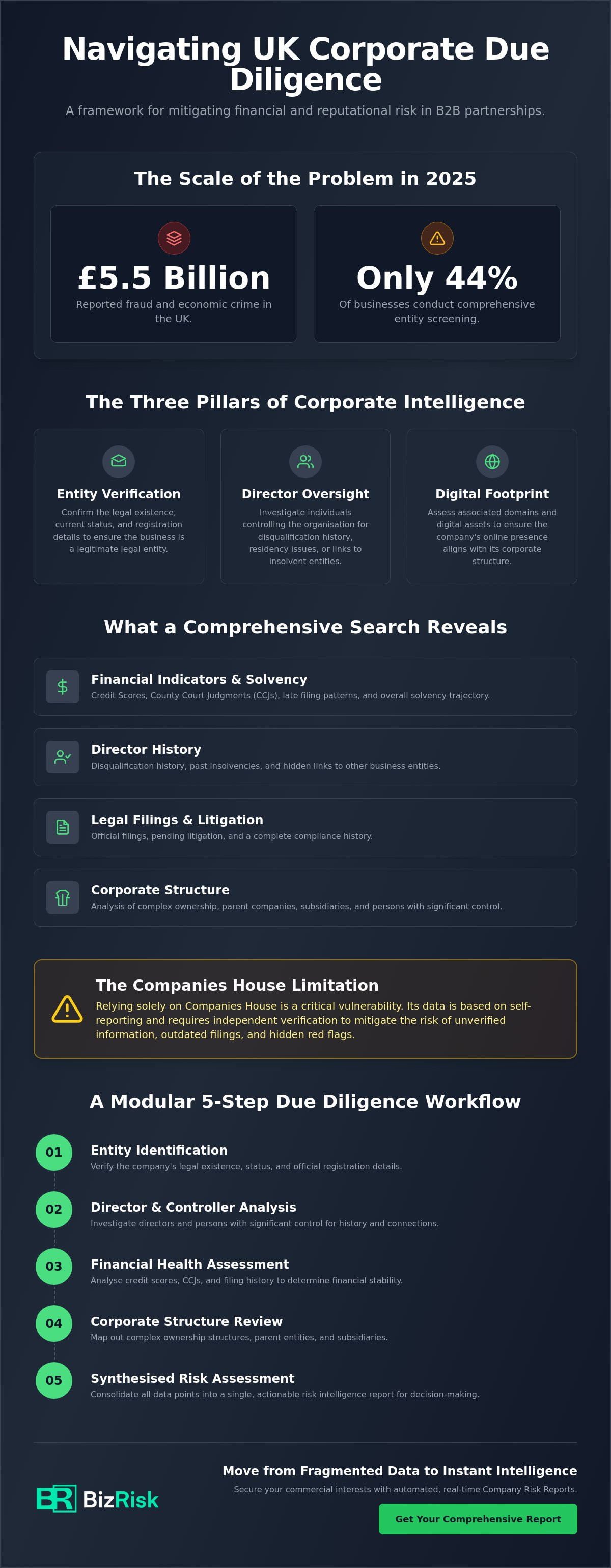
In 2025, reported fraud and economic crime in the UK reached a staggering £5.5 billion, yet only 44% of businesses conduct comprehensive entity screening. Relying on basic registry checks is a liability. A professional UK company background search must go beyond surface-level filings to uncover hidden insolvency risks and director disqualifications. You know that manual data collection is slow. Fragmented sources lead to information overload and the constant fear of missing a critical red flag in a director's history.
This guide provides a clinical framework for rapid corporate due diligence. You'll learn to navigate the updated regulatory landscape, including the June 2026 Money Laundering Regulations and mandatory identity verification requirements. We'll show you how to identify hidden risks amongst business entities and directors with speed and accuracy. Master the identification of disqualification risks and complex corporate structures. Expect a modular approach to business verification. We'll move from fragmented data to instant, actionable intelligence that secures your commercial interests.
Key Takeaways
- Distinguish between HR candidate screening and corporate due diligence. Focus on systematic reviews of legal, financial, and operational histories.
- Execute a thorough UK company background search. Identify CCJs, pending litigation, and insolvency risks before committing to high-stakes partnerships.
- Recognise registry limitations. Understand why Companies House data requires independent verification to mitigate the risk of unverified self-reporting.
- Implement a modular five-step workflow. Move rapidly from entity identification to comprehensive filing analysis and risk assessment.
- Adopt automated risk intelligence. Replace manual audits with structured Company Risk Reports for clinical, real-time decision-making.
Defining the UK Company Background Search
A UK company background search is a systematic review of an entity’s legal, financial, and operational history. It is the foundation of professional due diligence. Many service providers conflate this process with HR-led candidate screening, but the objectives are entirely different. While candidate screening focuses on individual employment history and personal references, corporate investigation evaluates the structural integrity of a business entity. This distinction is critical. In high-stakes environments like mergers and acquisitions or large-scale supplier onboarding, surface-level checks are insufficient. A professional search acts as a definitive mechanism to mitigate financial and reputational exposure before capital is committed.
The process involves aggregating data from multiple fragmented sources. It replaces guesswork with clinical accuracy. Relying on a single registry is a common failure in modern risk management. Professional searches synthesise disparate data points into a cohesive risk profile. This allows for rapid decision-making in volatile markets. Efficiency is the priority. You need intelligence that is both comprehensive and immediate. This search provides the clarity required to navigate complex B2B relationships without the burden of manual data collection.
The Three Pillars of Corporate Intelligence
Effective investigation relies on three distinct data layers. Each pillar provides a specific lens through which to view corporate risk.
- Entity Verification: Confirm the legal existence and current status of the company. This involves verifying registration numbers, active trading status, and official registered offices. It ensures the business is a legitimate legal person.
- Director Oversight: Investigate the individuals controlling the organisation. Identify disqualification history, residency issues, or hidden links to previously insolvent entities. A company is only as stable as its leadership.
- Digital Footprint: Assess the legitimacy of associated domains and digital assets. Ensure the company’s online presence aligns with its reported corporate structure. This identifies potential "shell" operations or domain-related security risks.
When to Conduct a Search
Timing is critical. Intelligence must precede action. There are three primary scenarios where a deep-dive investigation is non-negotiable.
Execute a UK company background search during pre-contractual negotiations with new suppliers or partners. Identifying risks early prevents downstream losses and legal entanglements. Ongoing monitoring is equally vital. Regular audits of existing business relationships detect early signs of insolvency or sudden changes in ownership that could impact your supply chain. Finally, use these searches for competitive intelligence. Understanding the financial health and director history of market rivals provides a strategic advantage within the UK territory. Knowledge of a competitor's CCJs or declining credit scores allows for more aggressive market positioning.
Core Data Points: What a Comprehensive Search Reveals
Data is the only objective measure of corporate risk. A comprehensive UK company background search reveals the internal mechanics of an organisation, moving beyond the surface-level data found when you Get information about a company through standard registry portals. Professional due diligence requires a granular analysis of four primary domains: financial health, legal filings, corporate structure, and director history. Each domain contains specific indicators that, when synthesised, form a definitive risk profile. Missing a single data point in any of these areas can lead to catastrophic financial or reputational exposure.
Financial Indicators and Solvency
Solvency is not a static state; it is a trajectory. Credit scores serve as the primary predictive tool for business failure. A low score often precedes formal insolvency by several months. Watch filing patterns closely. Late submission of accounts is a primary red flag. It suggests internal administrative collapse or a deliberate attempt to hide declining performance. Analyse the status of County Court Judgments (CCJs). An active CCJ indicates an unresolved debt and a failure to manage credit obligations. Whilst a satisfied CCJ shows a debt was eventually paid, its presence still signals past liquidity issues. For a deeper dive into these metrics, reviewing structured Company Risk Reports provides the necessary clarity for rapid decision-making.
Corporate structure analysis is equally vital. Uncovering the Ultimate Beneficial Owner (UBO) is a legal requirement under the June 2026 Money Laundering Regulations. You must look past the immediate parent company. Complex ownership chains often span multiple jurisdictions to hide the true source of wealth or control. A thorough search identifies the individual who ultimately benefits from the entity's activities. This prevents engagement with sanctioned individuals or entities involved in financial crime. Without this layer of intelligence, you risk violating strict UK compliance standards.
Director Track Records
A company's stability is tied to the individuals at the helm. Director history searches are essential for identifying "phoenix companies", which are entities formed from the remains of insolvent businesses to avoid debt. This behaviour is a major risk factor. Under the Economic Crime and Corporate Transparency Act 2023, identity verification is now compulsory. This makes it harder for disqualified individuals to operate under aliases. Check for current or past disqualification orders. Use cross-referencing to find hidden corporate links. A director holding multiple positions across seemingly unrelated entities may be managing a complex web designed to obscure liability. Identifying these connections is the only way to ensure the legitimacy of your business partners.
The Companies House Limitation: Why Basic Filings Aren’t Enough
Registry data provides a foundation. It does not provide a conclusion. When you Get information about a company, you're accessing a repository of self-reported information. Companies House is a registrar; it is not a risk-assessment body or a verification agency. Whilst the Economic Crime and Corporate Transparency Act 2023 introduced identity verification for directors, the registry remains largely reactive. It relies on the accuracy of submissions from the entities themselves. For a professional UK company background search, treating a registry filing as an absolute truth is a critical error in judgement. Intelligence must be dynamic, but registry data is inherently static.
The primary deficit in free data is the "data lag". UK companies typically file accounts once per year. This creates a significant window where a company’s financial health can deteriorate entirely undetected. By the time a deficit appears in the public record, the entity may have been insolvent for months. Relying on historic filings to make present-day credit decisions is a high-risk strategy. Professional due diligence requires real-time indicators that exist outside the annual filing cycle. Free data lacks the risk scoring and predictive analytics necessary to identify a failing business before the collapse is formalised.
The Verification Gap
An "Active" status on Companies House is not a certificate of financial stability. It simply means the company has met its basic filing obligations and hasn't been struck off. Fraudulent entities frequently exploit this. They maintain a veneer of legitimacy through timely, yet hollow, filings. Registry systems may not immediately flag "shadow directors" or complex webs of control designed to obscure liability. Without structured risk assessment, these red flags remain invisible. You're left with a snapshot that confirms an entity exists but fails to confirm if it should be trusted.
Aggregating Disparate Data Sources
Comprehensive intelligence requires the aggregation of data from across the UK legal and financial landscape. Registry data must be cross-referenced with High Court records and insolvency notices to capture a complete picture of litigation risk. Digital metrics have also become vital indicators of corporate legitimacy. Assessing domain age and the presence of secure SSL or MX records can distinguish a long-standing enterprise from a rapidly stood-up "shell" company. Real-time monitoring of these disparate sources is the only way to detect risk as it emerges. Waiting for the next annual return is a luxury your risk management strategy can't afford.
How to Conduct a UK Company Background Search in 5 Steps
Executing a UK company background search requires a methodical approach. Precision at the outset prevents investigative failure. Move through these five stages to convert raw data into a definitive risk assessment. This process ensures that no single point of failure compromises your due diligence.
- Step 1: Identify the exact legal entity name and registered number.
- Step 2: Access the primary registry for basic filing history and status.
- Step 3: Conduct a director-level audit to uncover previous failures or disqualifications.
- Step 4: Analyse financial health via credit reports and court record searches.
- Step 5: Synthesise digital risk factors, including domain and email legitimacy.
Step 1 & 2: Establishing the Legal Baseline
Accuracy begins with the unique eight-digit Company Number. Relying on names alone exposes you to "lookalike" entity fraud, where malicious actors register names similar to established brands. Verify this number against official documentation before proceeding. Once confirmed, cross-reference the reported "Nature of Business" via SIC codes against actual observed operations. Discrepancies here often signal shell company activity or a lack of operational transparency. Examine the registered office address. Distinguish between a legitimate trading address and a virtual office centre. A virtual office is common for startups; however, for established firms, the absence of a physical headquarters is a risk factor that warrants further scrutiny.
Step 3 to 5: Deep-Dive Risk Analysis
Move beyond the entity to the individuals in control. Search the Individual Insolvency Register and the Disqualified Directors Register. Identifying a director with a history of multiple failed ventures is the most effective way to predict future insolvency. You must also monitor The Gazette. This is the official journal of record for the UK. It lists notices of winding-up petitions or liquidation long before they are reflected in annual accounts. These filings are the definitive "early warning" indicators of terminal financial distress. They provide the clinical evidence needed to halt a partnership before losses occur.
Conclude the investigation by evaluating the digital footprint. A legitimate UK business should possess a mature domain with established SSL certificates and correctly configured MX records for email. If a company claims to be a high-turnover enterprise but operates from a newly registered domain with poor security configurations, it is likely a front. Synthesise these findings into a final risk score to determine the entity's viability. For immediate access to these data points without the manual burden, get a professional Company Risk Report to secure your decision-making process with data-driven accuracy.
Instant Risk Intelligence: Streamlining Your Due Diligence
Manual due diligence is a legacy process. It is slow, prone to error, and resource-heavy. Professional risk management now requires a UK company background search driven by automated intelligence. BizRisk eliminates the need for manual cross-referencing. It aggregates data from over ten distinct sources into a single, actionable risk score. This clinical approach provides a definitive verdict on entity legitimacy within minutes. You no longer need to wait days for a manual auditor to synthesise fragmented filings. Speed is the new standard for corporate oversight.
The system processes data from Companies House, The Gazette, High Court records, and insolvency registers simultaneously. It applies weighted algorithms to identify the severity of specific red flags. A late filing is a warning; an active winding-up petition is a terminal risk. By quantifying these variables, the platform provides a structured output that mirrors a professional digital workflow. This level of precision ensures that high-stakes decisions are based on the most current data available in the UK territory.
The BizRisk Advantage: Speed Meets Precision
Move beyond fragmented data. A unified Risk Intelligence Report synthesises financial, legal, and digital metrics to create a 360-degree view of corporate exposure. Efficiency is built into the workflow through three core pillars:
- Automated Monitoring: Stay informed of changes amongst your supplier list with real-time alerts.
- Director Oversight: Utilise Director Risk Reports to identify past failures or disqualifications across multiple entities.
- Digital Verification: Deploy Domain Risk Reports to confirm the security, age, and legitimacy of associated digital assets.
This tripartite strategy closes the loop on modern corporate risk. It addresses the digital vulnerabilities that traditional registry searches often ignore. Closing these gaps is essential for maintaining compliance with the June 2026 Money Laundering Regulations. You gain a comprehensive profile that includes ultimate beneficial ownership and cross-referenced directorships without the burden of manual investigation.
Integrating Risk Scores into Business Workflows
Structured findings reduce the cognitive load on legal and procurement teams. Instant reports allow for rapid decision-making during high-pressure negotiations. Use these scores to establish objective thresholds for supplier onboarding. This removes intuition from the process, replacing it with data-driven certainty. For those initiating a new verification process, the Free Risk Report offers a low-friction entry point to professional-grade intelligence. It provides immediate value whilst demonstrating the depth of the full investigative suite.
Generate your free UK company risk report instantly with BizRisk.
Secure Your Commercial Interests with Data-Driven Certainty
Corporate due diligence has evolved beyond the manual review of annual filings. A professional UK company background search now demands the simultaneous synthesis of entity status, director history, and digital legitimacy. Relying on unverified registry data is a strategic failure. You've seen that the data lag in public filings can hide terminal insolvency risks for months. Precision requires immediate, cross-referenced intelligence.
Efficiency is the ultimate safeguard. BizRisk aggregates data from over 10 authoritative UK sources to deliver structured risk scores in under two minutes. This clinical approach eliminates information overload. It provides the clarity needed for rapid procurement and partnership decisions. You don't have to navigate fragmented records or manual audits. The tool does the work; you make the decision.
Start your investigation with total confidence. Access a Free Risk Report for any UK entity to identify immediate red flags and secure your supply chain. Move from uncertainty to actionable intelligence today.
Get your instant UK company risk report now.
Frequently Asked Questions
Is it legal to perform a UK company background search on a competitor?
Yes, it is entirely legal. Most data used in a UK company background search is sourced from public records designed for corporate transparency. You don't need a specific legal justification or the competitor's consent to access their filing history, financial health, or director information. It is a standard practice for market analysis and competitive intelligence within the UK territory.
How long does a comprehensive business background check usually take?
Automated risk reports are generated in under two minutes. Manual searches involving multiple registers can take several hours or days to synthesise accurately. Speed depends on the tools used. Instant risk intelligence platforms provide structured data immediately, whereas manual audits are often delayed by registry data lag and the time required for human cross-referencing.
What is the difference between a credit report and a company background search?
A credit report focuses specifically on financial solvency and payment history. A UK company background search is more comprehensive. It integrates credit scores with director disqualification history, legal litigation records, and digital risk factors. Use a full background search to understand the structural and reputational integrity of an entity beyond its immediate balance sheet.
Can I see if a UK director has been disqualified online?
Yes, you can access this information via the official Disqualified Directors Register. This search identifies individuals banned from managing companies due to misconduct or insolvency. Professional risk reports automate this check, cross-referencing names against known aliases and previous failed ventures to ensure leadership legitimacy and compliance with the Economic Crime and Corporate Transparency Act 2023.
What are the primary red flags to look for in a UK company’s accounts?
Identify late filings and qualified audit opinions as immediate red flags. These suggest internal administrative failure or financial opacity. Rapidly increasing debt levels and declining net assets are also critical indicators of distress. Frequent changes in registered office addresses or sudden director resignations often precede formal insolvency notices and should be investigated with clinical precision.
Do I need the company’s permission to run a risk report in the UK?
No, you don't need the entity's permission for B2B due diligence. Most corporate data used in risk reports is part of the public record. Unlike consumer credit checks, which require explicit consent under GDPR, business entity verification is a standard requirement for anti-money laundering (AML) compliance and professional risk management. It is a non-intrusive, legal procedure.
What happens if a company I search has a County Court Judgment (CCJ)?
A CCJ indicates a court-ordered debt that remains unpaid. It significantly lowers a company's credit score and predicts future liquidity issues. Distinguish between active and satisfied judgments. An active CCJ is a major red flag; it suggests the entity is either unable or unwilling to meet its financial obligations, presenting a high risk for new creditors.
Can a background search identify the ultimate beneficial owner of a UK business?
Yes, a thorough search identifies the Ultimate Beneficial Owner (UBO). Under current UK regulations, companies must declare Persons with Significant Control (PSC). Advanced reports map these ownership chains to reveal the individuals who ultimately control the business. This process is vital for identifying sanctioned individuals or hidden links to other insolvent entities within complex holding structures.