
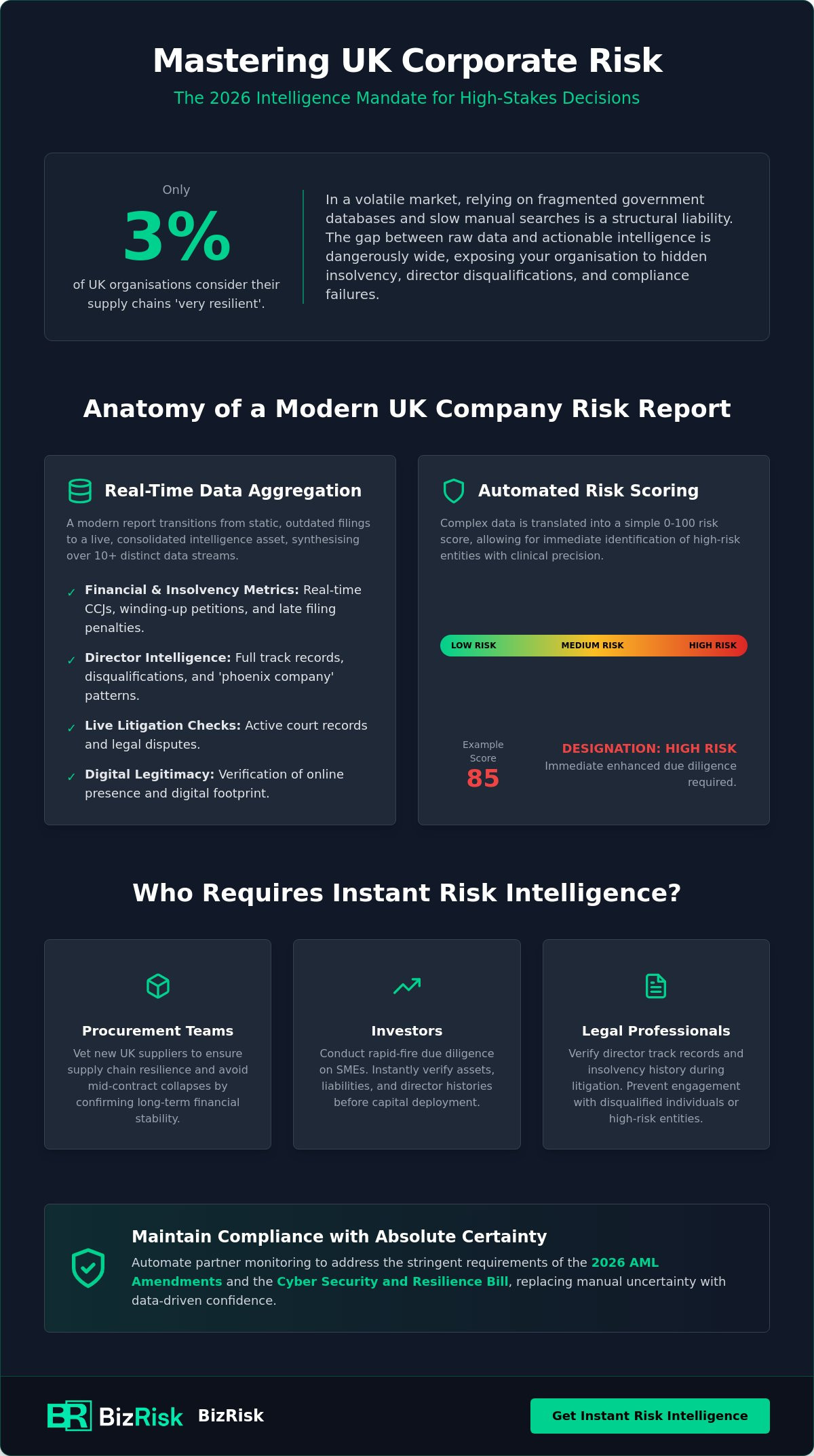
Only 3% of UK organisations consider their supply chains very resilient in 2026. For high-stakes decision-makers, the gap between raw data and actionable intelligence remains dangerously wide. Relying on fragmented government databases or slow manual searches isn't just inefficient; it's a structural liability. You need a UK company risk report that delivers intelligence at the speed of your workflow. You already know that hidden insolvency history or director disqualifications can derail a contract before the ink is dry. In an environment where the Bank of England base rate sits at 3.75% and inflation remains at 2.8%, financial precision is non-negotiable.
We'll show you how to master rapid corporate verification using automated due diligence and instant risk score generation. You'll learn to identify director red flags and verify digital legitimacy with clinical precision. This guide breaks down the process into three phases: aggregating fragmented data, interpreting comprehensive director histories, and implementing high-speed risk assessments. It provides the framework to address the Cyber Security and Resilience Bill and the 2026 AML amendments with absolute certainty. It's time to replace manual uncertainty with data-driven confidence.
Key Takeaways
- Transition from static filings to real-time data aggregation for immediate corporate decision-making.
- Identify the 10+ critical data sources required for a clinical risk assessment of any British entity.
- Interpret automated 0-100 risk scores to pinpoint "High Risk" designations with clinical precision.
- Optimise supplier onboarding by integrating a comprehensive UK company risk report into your digital workflow.
- Automate partner monitoring to maintain compliance with 2026 AML and cybersecurity regulations.
Understanding the UK Company Risk Report in 2026
A UK company risk report is no longer a static document. It is a consolidated intelligence asset designed for immediate application. In 2026, the speed of corporate decision-making dictates that data must be live. Traditional credit checks rely on trailing indicators; they tell you where a company was twelve months ago. Modern risk intelligence prioritises where a company is today. It aggregates financial, legal, and digital data points into a single, functional dashboard. This shift from retrospective filing to real-time aggregation is the only way to mitigate uncertainty in a volatile market.
The gap between a standard credit score and a comprehensive risk profile is significant. Whilst a credit check focuses on historic solvency, a risk report monitors active behavioural shifts, digital legitimacy, and live litigation. For businesses operating in an economy with a 3.75% base rate and 2.8% inflation, these nuances determine the difference between a secure contract and a total loss. Instant access is the baseline requirement. Waiting forty-eight hours for a manual search is a structural failure in a digital-first environment.
The Evolution of Corporate Due Diligence
Companies House remains a vital repository, yet its data is often months out of date. Private companies have nine months to file annual accounts. In that window, a healthy balance sheet can collapse into insolvency. The modern due diligence process demands more than a cursory glance at a balance sheet. It requires AI-driven pattern recognition to identify fraud amongst disparate data sets.
Regulatory pressures have intensified. The Money Laundering and Terrorist Financing (Amendment) Regulations 2026, effective from June 30, 2026, introduce stricter Enhanced Due Diligence (EDD) requirements. Compliance is no longer optional; it is a technical necessity. Relying on outdated filings whilst navigating these complex fraud landscapes creates unnecessary exposure. Automated intelligence bridges this gap by cross-referencing Companies House data with live court records and digital footprints.
Who Requires Instant Risk Intelligence?
High-speed intelligence serves three primary functions in the 2026 market. Each requires a specific lens of investigation to ensure operational security.
- Procurement Teams: Vetting new UK suppliers is critical for supply chain resilience. With only 3% of organisations feeling very resilient, procurement leads use risk reports to confirm long-term stability and avoid mid-contract collapses.
- Investors: Rapid-fire due diligence on SMEs is the standard for 2026. Investors require an instant UK company risk report to verify assets and liabilities before capital deployment.
- Legal Professionals: Verifying director track records and insolvency history is essential during litigation. Clinical data prevents the appointment of disqualified individuals or the engagement of high-risk entities.
Speed facilitates safety. By integrating automated intelligence into your workflow, you eliminate the cognitive load of manual verification. You receive a precise, data-driven profile that allows for rapid, high-stakes decision-making without the traditional delays of corporate investigation.
The Anatomy of a Comprehensive Risk Report
A clinical UK company risk report requires more than a single-source lookup. It synthesises over 10 distinct data streams into a singular, actionable profile. Raw data dumps are a liability; they increase cognitive load and delay critical decision-making. You need structured findings that bridge the gap between official Companies House filings and actual corporate behaviour. This integration of financial, legal, and digital data points creates a high-resolution image of counterparty risk that macro-economic assessments often overlook.
Financial and Insolvency Metrics
Financial health is measured by active signals, not just historic balance sheets. County Court Judgements (CCJs) serve as critical indicators. A single judgement might suggest an administrative error. Multiple judgements indicate systemic cash flow failure and a persistent refusal to meet obligations. Monitoring winding-up petitions and insolvency filings in real-time is non-negotiable. These filings often appear weeks before official registration updates. Late filing penalties also carry significant weight. If an entity misses its 9-month accounts deadline, it signals internal chaos and impending regulatory intervention.
Director Intelligence and Track Records
Corporate risk is often a reflection of leadership history. A comprehensive report identifies disqualified directors across multiple previous appointments. It traces "phoenix company" patterns amongst serial directors who abandon insolvent entities only to restart identical operations. You must evaluate the risk through a three-tier lens: identify disqualifications, trace phoenix patterns, and unmask shadow directors. These individuals often exert influence from the periphery to mask a history of corporate failure or legal disqualification. Understanding the human element behind the data prevents engagement with high-risk actors.
Domain and Digital Asset Risk
In 2026, digital legitimacy is a primary pillar of due diligence. Domain age and registration history provide immediate proof of business longevity. A company claiming a decade of experience whilst operating from a domain registered three weeks ago is a shell entity. Digital red flags include hidden WHOIS data, lack of security protocols, and frequent registrar changes. These anomalies suggest a lack of transparency or a temporary infrastructure designed to evade oversight. Secure your supply chain by generating a UK company risk report to verify these digital assets instantly.
Reliable intelligence requires the fusion of these disparate fields. By moving beyond macro-economic generalisations and focusing on specific counterparty behaviour, you mitigate uncertainty with clinical accuracy. This granular approach ensures that your due diligence process remains resilient against sophisticated corporate fraud.
Deciphering Risk Scores and Critical Red Flags
Automated intelligence transforms raw data into a numerical risk score, typically on a 0-100 scale. This score is not a subjective opinion; it is a weighted calculation of probability. A UK company risk report assigns values based on live insolvency signals, director history, and digital footprints. In the 2026 market, a "High Risk" designation generally applies to entities scoring below 30. This threshold indicates a high probability of corporate failure or regulatory intervention within the next twelve months. Understanding the components of this score is essential for rapid decision-making.
A checklist of high-impact red flags includes:
- Active winding-up petitions or multiple County Court Judgements.
- Direct association with disqualified or high-risk directors.
- Filing defaults exceeding 30 days from the Companies House deadline.
- Significant discrepancies in reported digital and physical infrastructure.
Yellow flags represent nuanced risks that require further investigation. These are not immediate disqualifiers but indicators of potential instability. For instance, a sudden shift in trade credit limits or a change in significant control (PSC) often precedes a structural pivot. Clinical due diligence treats these signals as prompts for enhanced verification rather than automatic rejection.
Identifying Corporate Red Flags
Suspicious entities often exhibit specific behavioural patterns in their filings. Frequent changes in registered office addresses, particularly to virtual office hubs, suggest a lack of permanent infrastructure. This behaviour is often an attempt to evade service of legal documents or hide operational scale. Monitor director resignation patterns closely. A mass exit of board members shortly before the financial year-end is a critical warning. It often signals internal awareness of impending insolvency or disputes regarding accounts accuracy. Additionally, evaluate the ratio of reported turnover to employee count. A reported turnover of £15 million managed by two employees is a statistical anomaly. It suggests a shell entity or high-risk financial behaviour that warrants immediate scrutiny.
Interpreting the Risk Score
Interpreting a risk score requires balancing financial stability against human reputation. A company may maintain a healthy balance sheet whilst being led by a director with a history of phoenixing insolvent businesses. In this scenario, the score will be suppressed to reflect the high risk of leadership failure. Remember that a low score does not always dictate a "do not trade" policy. It serves as a directive to proceed with caution. Use the UK company risk report to set specific credit limits or demand pro-forma payments for high-risk counterparties. Historical context is vital in 2026. With the Bank of England base rate at 3.75%, companies that were stable in a low-interest environment may now struggle. A clinical profile identifies these vulnerabilities before they manifest as a total default.
Integrating Risk Reports into Business Workflows
Manual due diligence is a structural bottleneck. In a market where cyber incidents and legislative shifts are the primary threats, your workflow must prioritise speed. Integrating a UK company risk report into your daily operations eliminates the lag between identification and action. It transforms due diligence from a reactive chore into a proactive filter. This integration is essential for maintaining compliance with the Money Laundering and Terrorist Financing (Amendment) Regulations 2026, which demand stricter oversight from June 30, 2026. High-speed data allows you to scale your operations without increasing your risk exposure.
Supplier and Partner Onboarding
Automate the first line of defence. Use clinical risk scores to establish "auto-reject" thresholds for new applicants. If an entity fails to meet a predetermined score, the system triggers an immediate block or escalates the file to Enhanced Due Diligence (EDD). This approach ensures that procurement teams don't waste hours on high-risk shell companies. Standardising this process across the organisation removes individual bias and ensures every partner meets your internal security standards. It is the most effective way to manage the 58% of UK business leaders who now rank corporate breaches as their top risk.
Strategic Decision Making
High-speed intelligence is the engine of 2026 M&A activity. Use director reports to vet potential board members or executives before formal negotiations begin. Identifying cross-directorships prevents conflicts of interest that could lead to legal complications or reputational damage. Beyond vetting, use stability data as a lever for commercial negotiation. Stable partners with high scores offer lower risk profiles; use this intelligence to secure better credit terms or more favourable contract durations. Data-driven negotiation replaces intuition with calculated financial leverage.
Risk is dynamic. A partner who is stable today may face a winding-up petition tomorrow. Only 3% of organisations consider their supply chains very resilient, largely due to a lack of ongoing oversight. Set up automated monitoring to receive alerts on CCJs, filing defaults, or director changes within your existing portfolio. This ensures you can pivot away from failing entities before they impact your bottom line. Automate your corporate intelligence to replace manual overhead with high-precision accuracy and maintain a clinical edge over your competitors.
By embedding these reports into your digital infrastructure, you reduce the cognitive load on your legal and procurement teams. You move from a state of constant investigation to a state of constant readiness. The result is a more resilient, compliant, and agile business that can react to the 2026 economic environment with absolute confidence.
Instant Risk Intelligence with BizRisk
Speed is the primary metric of successful due diligence in 2026. BizRisk provides the technical infrastructure for immediate corporate oversight. It bypasses the traditional 30-day trials and Skype-based demos required by legacy competitors. You enter a company name, director, or domain; the system delivers a comprehensive UK company risk report instantly. This is not a manual audit. It is an automated engine designed for clinical efficiency. It removes the friction of manual search and replaces intuition with data-driven certainty.
The platform operates through a simple, three-stage workflow. First, input the target entity details. Second, the system executes real-time data aggregation across financial and legal registries. Third, you receive a structured profile with a calculated risk score. This process ensures that your procurement and legal teams maintain a constant state of readiness. In an environment where the Bank of England base rate is 3.75% and inflation sits at 2.8%, your financial intelligence must be as current as the market itself.
The BizRisk Advantage: Speed and Scale
The BizRisk engine aggregates intelligence from over ten high-authority data sources in minutes. It doesn't just collect data; it organises it. You receive structured findings designed for rapid decision-making rather than a disorganised data dump. This clarity is essential whilst navigating the Money Laundering and Terrorist Financing (Amendment) Regulations 2026. Our architecture is built to handle high-volume enquiries without compromising on detail or accuracy.
Flexibility is a core component of the platform. We offer both subscription and pay-per-report models to suit your specific operational volume. Whether you're vetting a single high-value partner or monitoring an entire supply chain, the intelligence scales to your requirements. This modular approach allows you to control costs whilst maintaining a high standard of corporate oversight. You don't need to wait for a consultant's report when the data is available in seconds.
Mitigating Uncertainty Immediately
Waiting for manual audits is a risk in itself. In the time it takes to complete a traditional background check, a target company's financial position can shift significantly. Uncertainty creates friction, and friction leads to loss. A precise, calculated risk score provides the confidence to move at the speed of the 2026 economy. It identifies the 58% of UK business leaders who are currently vulnerable to cyber breaches and corporate instability before you commit capital.
Clinical accuracy is the only way to protect your interests amongst shifting legislative requirements. Use our platform to verify digital legitimacy and director track records with absolute precision. Take the first step towards automated due diligence with a Free Risk Report. Experience the speed of a UK company risk report that delivers intelligence exactly when you need it. Secure your workflow, eliminate manual overhead, and execute your decisions with data-driven authority.
Secure Your Corporate Interests with Instant Intelligence
Corporate due diligence in 2026 is a race against information decay. Relying on static filings whilst navigating the Money Laundering and Terrorist Financing (Amendment) Regulations 2026 is a structural vulnerability. You've seen how clinical data aggregation and automated risk scores eliminate the cognitive load of manual investigation. By prioritising speed, you secure your supply chain and protect your capital from high-risk shell entities and disqualified directors.
A comprehensive UK company risk report provides the transparency needed for high-stakes decision-making. Transition from reactive audits to a proactive, data-driven workflow. Leverage instant data from 10+ high-authority sources and implement no-nonsense clinical risk scoring to maintain your competitive edge. Trusted by UK decision-makers for rapid due diligence, this technical infrastructure ensures you move at the pace of the modern market.
Mitigate uncertainty with clinical precision. Your operational security depends on the speed of your intelligence. Generate your instant UK company risk report today and secure your business interests with data-driven authority.
Frequently Asked Questions
What is included in a UK company risk report?
A UK company risk report aggregates data from over 10 high-authority sources to provide a high-resolution profile of any entity. It includes County Court Judgements (CCJs), winding-up petitions, and insolvency filings alongside Companies House records. You also receive director track records and digital asset verification. This structured intelligence allows for rapid assessment of counterparty reliability without the traditional delays of manual search processes.
How often is the risk data updated in a BizRisk report?
Data aggregation occurs in real-time at the point of enquiry. Our system executes live lookups across financial and legal registries to ensure you receive the most current intelligence available. This eliminates the lag associated with static database snapshots. In 2026, where corporate stability can shift rapidly, this immediacy is essential for maintaining accurate due diligence standards. You receive data based on the most recent filings.
Can I check a director’s history if they have multiple companies?
Yes, the platform identifies all current and previous appointments associated with a specific individual. It traces cross-directorships to reveal potential conflicts of interest or "phoenix company" patterns. You can view the insolvency history and disqualification status of directors across their entire career. This granular oversight prevents engagement with serial high-risk actors who hide behind multiple corporate entities to evade regulatory scrutiny.
Is a free risk report as accurate as a paid subscription?
Every Free Risk Report utilises the same high-authority data sources and clinical scoring algorithms as our paid models. The primary difference lies in the depth of historical data and the volume of reports permitted per user. Paid tiers offer more comprehensive director histories and advanced digital asset monitoring. For initial discovery, the free option provides a reliable, data-driven baseline for immediate UK company risk report generation.
What is a "red flag" on a UK business background check?
A red flag is a high-impact indicator of corporate instability or regulatory non-compliance. Typical examples include active winding-up petitions, multiple CCJs, or the presence of a disqualified director. Frequent changes in registered office addresses or missed filing deadlines also trigger these warnings. Identification of these signals within a UK company risk report mandates immediate caution or the implementation of enhanced due diligence protocols.
How does domain risk assessment work for UK businesses?
Domain risk assessment verifies the digital legitimacy of a business by analysing registration history and security protocols. It examines domain age to identify shell entities that lack a long-term digital footprint. Frequent registrar changes or hidden WHOIS data often signal a lack of transparency. This technical layer ensures that a company's online infrastructure matches its reported corporate history and reported physical scale.
Can I use these reports for AML and KYC compliance?
Yes, these reports provide the technical data required for Anti-Money Laundering (AML) and Know Your Customer (KYC) compliance. They facilitate the Enhanced Due Diligence (EDD) mandated by the June 30, 2026 regulatory amendments. By automating the verification of beneficial owners and identifying high-risk transactions, you ensure your organisation meets all legal obligations with clinical accuracy. It is a vital tool for modern compliance officers.
What happens if a company I am monitoring changes its risk score?
Automated monitoring triggers an immediate alert if a target entity's risk score fluctuates beyond a set threshold. This allows you to react to new CCJs, insolvency filings, or director resignations before they impact your operations. Constant oversight replaces the outdated "one-and-done" audit approach. It ensures your supply chain resilience remains high in an environment where economic conditions shift with high volatility.