
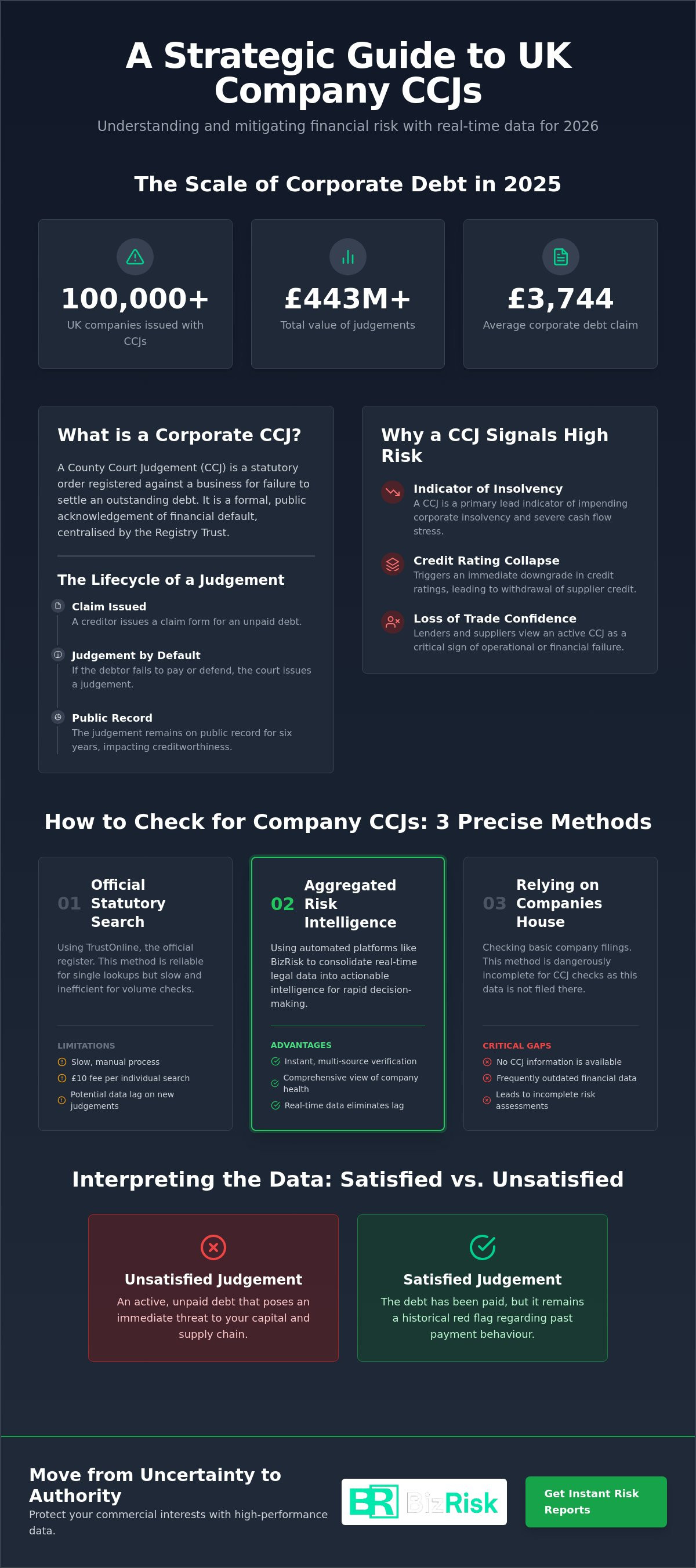
In 2025, over 100,000 UK companies were issued CCJs with a total value exceeding £443 million. With the average corporate debt claim rising to £3,744, your exposure to bad debt has never been higher. You must check for company CCJs UK before committing to new contracts or extending credit terms. Relying on fragmented data or delayed reporting is a strategic failure. Manual searches across multiple registries waste valuable time and often return outdated results that compromise your professional decision-making.
You understand that effective risk assessment requires clinical precision and real-time intelligence. This 2026 guide provides the framework to identify County Court Judgements and mitigate financial risk using live data. You'll learn to differentiate between satisfied and unsatisfied judgements instantly while navigating the latest court fee updates. We'll examine how to generate a comprehensive risk score to protect your capital. Move from manual uncertainty to automated authority. Stop wasting resources on slow searches and start using high-performance data to secure your commercial interests.
Key Takeaways
- Identify why a County Court Judgement serves as a primary indicator of corporate insolvency and imminent financial distress.
- Access the three most precise methods to check for company CCJs UK including direct statutory registry searches and manual filing reviews.
- Differentiate between satisfied and unsatisfied judgements to evaluate whether a debt remains an active threat to your capital.
- Recognise the critical data gaps in Companies House filings that frequently lead to outdated or incomplete risk assessments.
- Utilise comprehensive Company Risk Reports to consolidate real-time legal data into actionable intelligence for rapid decision-making.
What is a Corporate CCJ and Why It Signals High Risk
A County Court Judgment (CCJ) is a statutory order registered against a business for failure to settle an outstanding debt. It represents a formal legal acknowledgement that a company has defaulted on its financial obligations. In England and Wales, these records are centralised and maintained by the Registry Trust. This data is the most critical component of corporate due diligence. When you check for company CCJs UK, you are performing a diagnostic on a firm's liquidity. Precise intelligence prevents you from entering high-risk contracts with insolvent entities.
A single judgement often triggers an immediate downgrade in credit ratings. This leads to the withdrawal of supplier credit and a collapse in trade confidence. Lenders and suppliers view an active CCJ as a signal of high risk. It suggests that the company's internal controls have failed or their cash reserves are exhausted. Once a judgement is registered, it becomes a public record that informs the decisions of every major financial institution in the country. It's the primary lead indicator of impending corporate insolvency.
The Legal Lifecycle of a Judgment
Judgements don't occur in isolation. They follow a specific legal timeline. The process begins with the issue of a claim form. The debtor has 14 days to respond, or 28 days if they file an acknowledgement of service. If they fail to pay or defend, the court issues a judgement by default. High Court Judgments (HCJs) differ from County Court versions primarily in scale and enforcement. Debts over £600 can be transferred to the High Court for enforcement by High Court Enforcement Officers. This allows for the issue of a Writ of Control, which is a faster and more aggressive method of asset seizure. Regardless of the court level, the Registry Trust retains these records for six years. During this window, the judgement remains a public stain on the company's record. It serves as a permanent warning to potential creditors about past payment behaviour.
CCJs as a Proxy for Cash Flow Issues
Not all judgements indicate total failure, but most signal severe stress. You must distinguish between administrative errors and a genuine inability to pay. One large, contested judgement might suggest a legal dispute over service quality. Conversely, multiple small judgements are a severe red flag. This pattern indicates a systemic failure to manage routine overheads. It suggests a strategy of prioritising certain creditors whilst ignoring others, which often precedes total collapse. Historical data shows a direct correlation between active CCJs and the eventual filing of winding-up petitions. Use Company Risk Reports to identify these patterns early. Precise intelligence allows you to adjust credit terms before a partner's cash flow issues become your financial loss. You need to check for company CCJs UK to ensure your supply chain remains robust and reliable.
How to Check for Company CCJs UK: 3 Precise Methods
To check for company CCJs UK, you must first ensure you are querying the correct legal entity. Many businesses operate under trading names that differ from their registered name. Use the precise Registered Office address and Company Registration Number (CRN) to avoid entity confusion. Accuracy at this stage is non-negotiable. A search against the wrong entity name will return a false negative, leaving your capital exposed to an unidentified risk. Verify the registration details via Companies House before initiating any statutory search.
Method 1: Official Statutory Searches
The primary source for debt data is the TrustOnline official register. This platform provides access to the Register of Judgments, Orders and Fines for England and Wales. Each individual search costs £10. Whilst reliable, this method is limited to single-entity lookups. It requires manual input for every query. This process is slow and often misses "in-flight" judgements that have been issued but not yet fully indexed in the public-facing portal. For high-volume due diligence, relying solely on manual lookups creates a dangerous intelligence lag that fails to account for the 100,000 judgements issued annually.
Method 2: Aggregated Risk Intelligence
Professional credit controllers use automated platforms like BizRisk for instant multi-source verification. These tools aggregate data from the Registry Trust, Companies House, and proprietary datasets. You gain a comprehensive view of a company's health in seconds. This method provides three critical advantages:
- Multi-dimensional visibility: View CCJs alongside director history and domain risk to spot "phoenix" company patterns.
- Real-time monitoring: Receive immediate alerts the moment a new judgement is registered against a monitored entity.
- Proprietary risk scores: Move beyond binary data to understand the statistical probability of default.
Consolidating these data points into a single Company Risk Report eliminates the need for manual cross-referencing. It provides a structured workflow for rapid decision-making in high-stakes environments.
Method 3: Companies House Filing Reviews
Whilst Companies House does not maintain the primary CCJ register, it remains a vital secondary source for manual review. Examining the "Filing History" can reveal notified legal actions, such as winding-up petitions or notices of administrator appointments. These filings often provide the context behind a judgement. However, there is a significant lag time between a court action and a public filing notification on Companies House. Use this method only to supplement official registry data. If you require immediate clarity on a potential partner's status, you can request a professional risk assessment to verify their current standing with clinical precision.
Interpreting the Data: Satisfied vs Unsatisfied Judgments
CCJ data is not binary. It requires precise interpretation to gauge actual risk levels. The Registry Trust marks a judgement as "Satisfied" only once evidence of payment is submitted to the court. If a debtor settles the full amount within 30 days of the judgement date, they can have the entry removed from the register entirely. Payments made after this 30-day window result in the entry remaining visible for six years, marked as settled. Effective due diligence requires you to check for company CCJs UK and accurately categorise these results by their legal status. Creditors usually make a court claim for money as a final resort; a judgement is the ultimate proof of a failed negotiation.
A Set Aside is a legal process where a judgement is cancelled by the court, usually because the defendant has a valid defence or was unaware of the original claim. Understanding this distinction prevents you from misjudging a company that has successfully challenged a wrongful claim.
Risk Assessment of Satisfied Judgments
A satisfied CCJ is not a clean bill of health. It proves a company only pays when compelled by the legal system. This "pay-on-judgment" behaviour indicates poor administrative control or chronic liquidity issues. Whilst the debt is settled, the entry continues to suppress corporate credit scores for the remainder of its six-year term. Procurement teams should analyse the frequency of these events. A single satisfied judgement from five years ago is a minor historical note. Three satisfied judgements in the last 18 months suggest a systemic failure to manage cash flow. You're dealing with a partner that treats the court system as a credit management tool.
The Danger of Unsatisfied CCJs
An unsatisfied judgement is the primary red flag for any credit controller. It represents a total breakdown in creditor relations. This status suggests the company either lacks the assets to settle or is deliberately evading its legal obligations. Detection of an active CCJ should trigger an immediate review of procurement terms. Switch to pro-forma payments or reduce credit limits instantly. Before extending significant credit, you should contact BizRisk for a comprehensive risk assessment to verify the current standing of the entity. Do not ignore an active judgement. It is often the final warning before a winding-up petition is filed. When you check for company CCJs UK, an unsatisfied status is a clear signal to pause all unsecured exposure.
Why Companies House Data Isn’t Enough for CCJ Checks
Relying on Companies House for debt verification is a critical error. The Registrar of Companies serves as a repository for corporate structure and historical financial statements. It is not a live debt register. The primary statutory record for civil judgements resides with the Registry Trust. This distinction is vital for accurate due diligence. A company may appear active and compliant on Companies House whilst harbouring multiple unsatisfied judgements. Small claims judgements rarely appear in standard annual accounts due to materiality thresholds. Relying on "Good Standing" certificates is equally dangerous. These documents only verify that a company is up to date with its filings. They ignore active civil litigation and outstanding debt. To effectively check for company CCJs UK, you must access the specific registries that track default judgements in real time.
Data Silos in UK Corporate Oversight
The UK regulatory landscape is defined by fragmented data silos. There is a significant disconnect between the Insolvency Service, the Courts, and the Registrar of Companies. Information does not flow automatically between these agencies. A judgement issued in the County Court may take weeks or months to impact a company's public credit profile. BizRisk bridges these gaps by aggregating data from over ten distinct sources into a single interface. This allows you to cross-reference director track records with current company judgements. Identifying a director with a history of dissolved entities and unsatisfied debts is the only way to predict future default. Clinical precision requires the consolidation of these disparate data points.
Instant Background Checks vs. Periodic Audits
Financial audits provide a retrospective view of corporate health. A 12-month-old audit is useless for identifying a judgement issued last week. Modern UK procurement has shifted toward continuous monitoring to mitigate risk. This proactive approach identifies red flags the moment they are registered. It is the only effective defence against "Phoenix" companies. These entities allow directors to move debt between different legal structures whilst maintaining a veneer of respectability. You must check for company CCJs UK using live data to ensure your intelligence is current. Static reports are obsolete in a high-speed commercial environment. If you require a deep-dive into a potential partner's litigation history, request a professional risk assessment to secure your supply chain today.
BizRisk: Instant Business Background Checks and CCJ Intelligence
Speed is the primary metric of effective risk mitigation. Waiting for manual registry updates or relying on outdated periodic audits is a strategic liability you cannot afford. BizRisk provides a high-performance engine for corporate intelligence. It allows you to generate a structured due diligence report in minutes. You move from raw data to actionable insight without the administrative lag associated with traditional searches. To check for company CCJs UK effectively, you need a system that aggregates disparate data streams instantly. Our platform delivers clinical, data-driven insights designed specifically for high-stakes decision-making. You gain a level of certainty that manual lookups simply cannot match.
Reliability is built into every search. We provide real-time CCJ data alongside proprietary risk scores that calculate the statistical probability of a partner defaulting. This comprehensive coverage extends beyond simple debt markers. We investigate director history and domain legitimacy to provide a 360-degree view of corporate health. You identify "Phoenix" patterns and insolvency risks before they impact your balance sheet. Our utility is designed for professionals who value logic, data, and rapid execution.
The Anatomy of a BizRisk Report
Every report is engineered for immediate "Go/No-Go" decisions. We utilise a visual risk scoring system that synthesises complex variables into a single, intuitive metric. You get granular visibility into legal judgements, financial health, and corporate structure. Each report breaks down the data into three critical phases: identification, assessment, and conclusion. Use our platform for instant business background checks to verify any UK entity with clinical precision. We don't just provide data; we provide a diagnostic tool for professional environments. You see the exact status of every judgement, the filing history of the directors, and the overall liquidity of the business in a single, modular view.
Secure Your Supply Chain Today
Eliminate uncertainty. Aggregated risk intelligence is your most effective defence against bad debt and insolvency contagion. Our platform bridges the gaps between the courts and the Registrar of Companies. You gain comprehensive coverage that includes director track records and domain risk. This ensures that you check for company CCJs UK with the highest level of accuracy available in the 2026 market. Precision leads to protection.
Access is flexible and designed to scale with your requirements. Choose between our Company Risk Reports for ad-hoc due diligence or subscription tiers for continuous monitoring of your entire ledger. Stop reacting to financial crises and start predicting them. Request a consultation or trial access to our risk platform to integrate high-speed intelligence into your procurement workflow today. Secure your capital. Protect your operations. Move with confidence.
Secure Your Commercial Interests with Real-Time Intelligence
Effective risk management requires moving beyond static, fragmented records. You've identified why relying solely on Companies House is a strategic failure and how to interpret the critical differences between satisfied and unsatisfied judgements. To check for company CCJs UK with clinical precision, you must utilise automated systems that bridge the gap between court actions and public filings. Manual searches are too slow for the 2026 commercial landscape. Delaying your due diligence is an unnecessary exposure to bad debt.
BizRisk delivers this intelligence through high-speed reporting and instant risk scoring. Our platform aggregates data from over 10 statutory sources to eliminate uncertainty. Don't wait for a default to reveal a partner's instability. Get instant risk intelligence on any UK company to protect your capital and supply chain today. High-performance data ensures your decisions are rooted in fact rather than intuition. Move forward with total confidence in your corporate oversight.
Frequently Asked Questions
How can I check if a UK company has a CCJ for free?
Official registry searches via TrustOnline require a £10 fee per search. You can't access the statutory register for England and Wales without charge. Whilst Companies House is free to use, it doesn't record CCJs or other civil court judgements. You may utilise a Free Risk Report for initial screening, but comprehensive intelligence usually involves a fee to cover data aggregation costs. Precision requires paying for access to the primary register to ensure your data is accurate.
How long does a CCJ stay on a company’s credit report?
A CCJ remains on the public register and a company's credit profile for exactly six years from the date of judgement. This duration is fixed regardless of whether the debt is eventually settled. Credit reference agencies use this data to suppress credit scores throughout the entire six-year window. Only judgements paid within 30 days are removed entirely from the record. Otherwise, the entry serves as a permanent warning to all potential creditors and suppliers until it's naturally purged.
Can a company get a CCJ removed if they pay the debt?
Removal is only possible if the debt is settled in full within one calendar month of the judgement date. If payment occurs after this 30-day window, the entry remains visible for six years but it's updated to a satisfied status. To clear an entry after one month, you must apply for a Set Aside via the court. This requires proving a valid legal defence or administrative error, such as the claim form being sent to an incorrect address.
Does a CCJ mean a company is going bust?
A CCJ is a lead indicator of financial distress but it's not a guarantee of imminent insolvency. It's proof a company has failed to manage its cash flow or resolve a legal dispute. However, multiple judgements often precede a winding-up petition. You must check for company CCJs UK to determine if a partner is experiencing systemic liquidity issues or a one-off administrative failure. Clinical assessment is vital to distinguish between a minor dispute and a total collapse.
What is the difference between a satisfied and unsatisfied CCJ?
An unsatisfied CCJ indicates the debt remains unpaid and the court order is ignored. This represents the highest level of credit risk for any procurement team. A satisfied judgement confirms the debt was eventually settled, though usually only after legal compulsion. Whilst a satisfied status is preferable, it still demonstrates a history of late payment that'll negatively impact corporate creditworthiness for six years. It's a signal that the entity only pays when forced by the court system.
How often is the UK CCJ register updated?
The Registry Trust processes court data daily. Most credit intelligence platforms sync with these updates to provide near real-time visibility into new judgements. However, there's often a lag between a court hearing and the judgement appearing on the public register. Using automated monitoring ensures you receive alerts as soon as a judgement is indexed. This mitigates the risk of relying on outdated periodic audits that fail to capture the most recent changes in a company's standing.
Can I check for CCJs against a company director personally?
You can perform a search against an individual director using a Director Risk Report. This identifies personal judgements that may indicate a pattern of financial mismanagement. Personal CCJs are often more revealing than corporate ones. They'll highlight the individual's history across multiple failed ventures. This cross-referencing is essential for identifying Phoenix company risks where debt is shifted between legal entities. Understanding the person behind the business is as critical as checking the business itself.
What should I do if a supplier has an active CCJ?
Immediate action is required if a supplier shows an active judgement. Switch to pro-forma payments to protect your capital and review the stability of your supply chain. An active CCJ suggests the supplier may soon face enforcement action or insolvency. Conduct a deep-dive investigation to determine if you need to source an alternative partner before their operational failure impacts your own business delivery. Don't extend further credit until the judgement is marked as satisfied or set aside.